The Minister of Planning and Economic Development (MoPED), H.E. Madam Kenyeh Barlay, together with the ECOWAS Resident Representative to Sierra Leone, H.E. Ambassador John Azumah, led a high-level engagement with government ministries, departments, agencies, and local authorities in Sorogbema Chiefdom, Pujehun District, during the official handover ceremony for the construction of the Wai Cross-Border Market. The event, marked by colorful cultural displays and strong community participation, signaled the commencement of a transformative infrastructure project.
The ceremony took place on November 17, 2025, as part of ECOWAS’s 50th Anniversary celebrations and a week-long sensitization on development interventions in Sierra Leone.
The Wai Cross-Border Market project MoPED/ECOWAS/RB/WORKS/2025/001 falls under the ECOWAS Cross-Border Cooperation Support Programme (ECBCSP) through the Directorate of Free Movement and Migration, and is implemented by MoPED with the Ministry of Works and Public Assets providing supervisory oversight. Sierra Brothers Construction Services (SL) Limited is contracted to execute the project, which is strategically located at a key economic corridor linking more than seven major crossing points between Sierra Leone and Liberia.
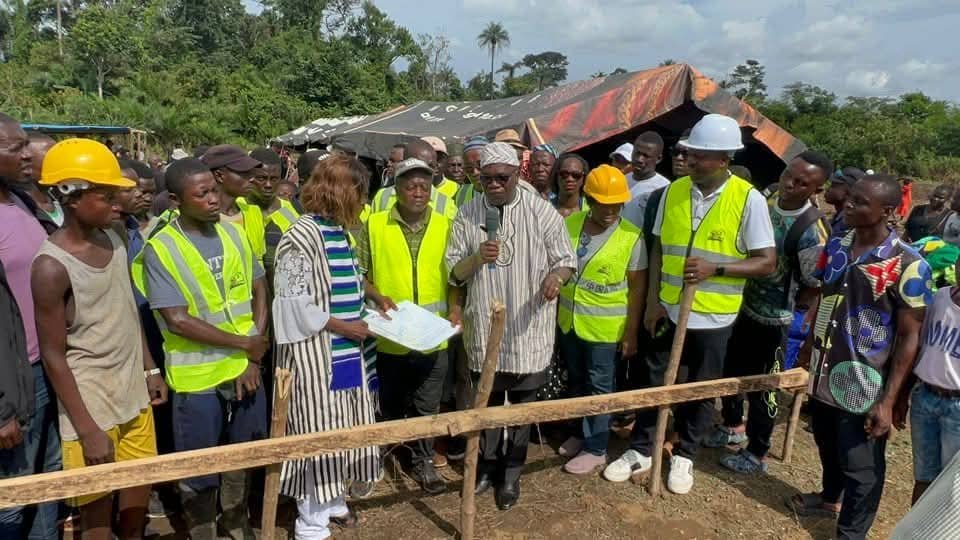
The initiative aligns with the ECBCSP 2023–2027 operations, officially launched in May 2024 in Freetown, aimed at strengthening regional peace and security, managing migration and free movement, and promoting joint socio-economic development in border communities. It reflects growing cooperation between ECOWAS, the Government of Sierra Leone, local councils, and community leadership.
The ceremony was chaired by the Chiefdom Speaker, Mr. Augustine Kah Zoker, who expressed heartfelt appreciation to ECOWAS and the Government for bringing tangible development to a remote community like Wai. Paramount Chief P.C. Mustapha J. Massaquio applauded MoPED for actualizing the long-anticipated market project and encouraged his people to leverage the opportunity to enhance livelihoods and security.
Construction Manager Ibrahim Kawa, representing the contractor, assured community members that the project would be completed within four months, with 80 percent of the workforce recruited locally to promote ownership and economic benefit.
Ambassador Azumah highlighted the project’s importance in advancing regional trade, cooperation, and social cohesion. He emphasized ECOWAS’s shift from an “ECOWAS of States” to an “ECOWAS of People,” centering community-focused development in its 50-year journey, and praised Sierra Leone’s contributions to regional integration.
Minister Kenyeh Barlay celebrated Sorogbema Chiefdom’s economic potential, emphasizing its rich fisheries, beaches, and agricultural productivity. She underscored the market’s alignment with ECOWAS Vision 2050 and Sierra Leone’s national priorities, including the Feed Salone Programme. She encouraged community residents to embrace the new market as a boost to local commerce, cross-border trade, and living standards.
Plans to incorporate cold storage facilities into the market design were announced to strengthen fisheries and agricultural value chains. The Minister also highlighted priorities such as mechanized agriculture, strengthened health services, youth entrepreneurship, and enhanced coordination between island and mainland communities.
Deputy Development Secretary III and Head of the ECOWAS National Office, Mr. Komba Momoh, noted that the Wai Market project is one of several ECOWAS interventions in Sierra Leone aimed at improving livelihoods, promoting human capital, and strengthening cross-border cooperation.
Community representative Madam Kadiatu Bambay Kallon from Zimmi praised MoPED and ECOWAS for prioritizing women’s economic empowerment through the market project, describing it as a crucial driver of socio-economic transformation.
The ceremony concluded with a renewed commitment from all partners to deepen development cooperation, strengthen regional ties, and support sustainable growth, with the Wai Market expected to become a key engine of trade and livelihoods for thousands of border residents.