By: yusufibrahimkamara@hopemediasl.com
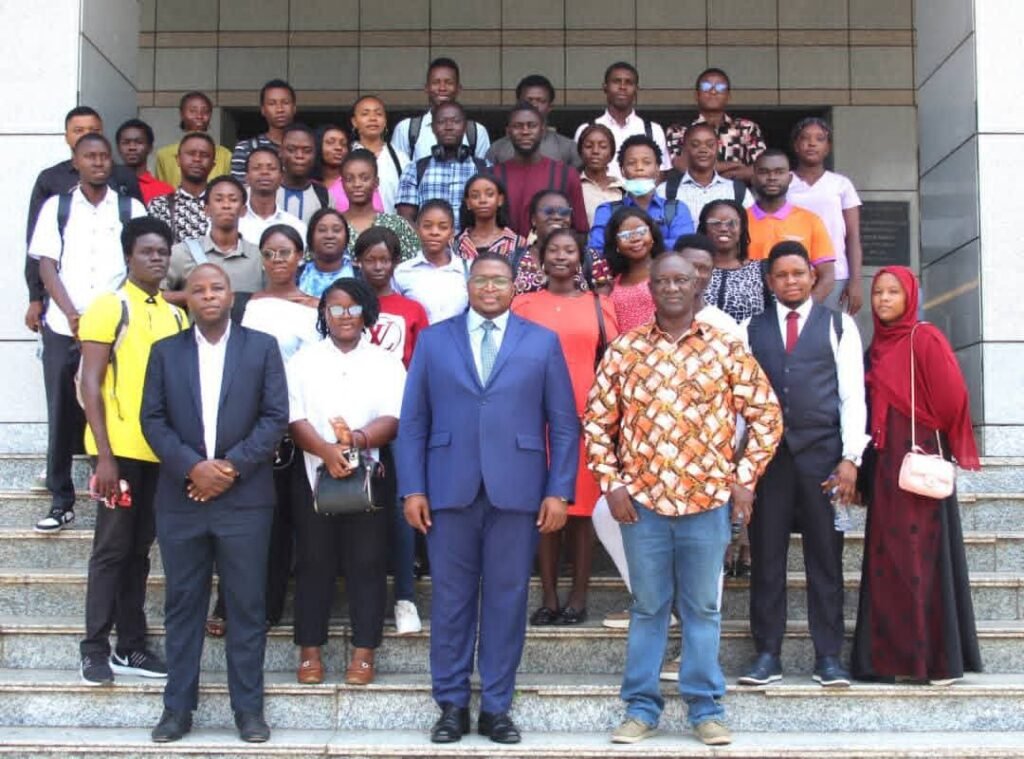
The quiet formality of the Ministry of Foreign Affairs and International Cooperation was transformed into a vibrant arena of ideas and critical reflection as final-year Mass Communication students from Fourah Bay College stepped beyond the lecture hall and into the demanding world of diplomacy, power politics, and global communication. What unfolded was not a routine academic visit, but an extended engagement with the realities shaping today’s international system and the role communicators must play within it.
The interaction took place on January 16, 2026, in the Ministry’s Conference Room, where the students were hosted by Sierra Leone’s Minister of Foreign Affairs and International Cooperation, Alhaji Timothy Musa Kabba. The visit was led by Isaac Massaquoi, Head of Department and Director at Fourah Bay College, under the University of Sierra Leone, and formed part of a broader effort to connect academic training with the lived practice of governance and international relations.
The timing of the engagement was particularly significant. Faculty members used the occasion to formally introduce a new academic module titled National Affairs, designed to expose students to the practical dimensions of state policy, diplomacy, and governance. The course aims to sharpen students’ analytical capacity, enabling them to interrogate policy decisions, understand institutional processes, and participate meaningfully in national and global conversations beyond theoretical frameworks.
Welcoming the students, Minister Kabba described them as inheritors of a storied intellectual tradition, invoking Fourah Bay College’s long-standing reputation as the “Athens of Africa.” He framed their presence at the Ministry not as a ceremonial visit, but as a call to responsibility. Drawing from his own unconventional journey from engineering into diplomacy, he emphasized that communication lies at the very heart of international relations. In his words, effective diplomacy is inseparable from effective communication, and the ability to articulate policy, values, and national interests remains a defining skill in global engagement.
He urged the students to see themselves as future interpreters of policy and mediators of national narratives, stressing that peace-building, stability, and development are advanced not only through treaties and negotiations, but through clear, strategic, and ethical communication. In an era of misinformation and polarized global discourse, he noted, communicators occupy a critical frontline.
Turning to the global context, the Minister delivered a sobering assessment of the current international order. He described a system in flux, where long-standing norms are increasingly undermined and international law is often selectively applied. As a stark illustration, he referenced the unprecedented removal of a sitting sovereign head of state for trial in a foreign jurisdiction, characterizing the action as a serious challenge to the principles enshrined in the UN Charter. Such developments, he argued, define the unstable and contested terrain that today’s graduates must be prepared to navigate.
Within this unsettled environment, Minister Kabba outlined the structure and practice of modern diplomacy, distinguishing between bilateral relations and multilateral engagement, particularly within institutions such as the United Nations. Established in the aftermath of World War II to safeguard global peace and security, the UN, he noted, now confronts questions about its legitimacy, relevance, and effectiveness.
This critique was grounded in Sierra Leone’s own recent diplomatic experience, as the country has just commenced an elected term on the UN Security Council. From that vantage point, the Minister argued that reform of the Council is no longer optional but imperative. He highlighted what he termed a democratic deficit in the Council’s permanent membership, where veto power remains concentrated among a few states, with Africa entirely excluded.
“Africa, with 54 member states and nearly a quarter of the UN’s total membership, has no permanent seat at the table where the most consequential decisions are made,” he observed, tracing this imbalance to the historical context of the UN’s founding in 1945, at the height of colonial rule. He reaffirmed Sierra Leone’s commitment to the Common African Position adopted in 2005, which calls for fair representation for Africa in both permanent and non-permanent categories of the Council. Such reform, he argued, is essential if the body is to command legitimacy, especially given that many of its deliberations focus on African conflicts and crises.
Reflecting on the tools of international diplomacy, Minister Kabba contrasted the past and present effectiveness of UN sanctions. He recalled the comprehensive sanctions imposed on Sierra Leone in 1997, which led to the country’s isolation and contributed to internal instability, demonstrating the once-formidable power of such measures. Today, however, he noted that sanctions are frequently circumvented, mirroring a broader global environment where international rules are increasingly ignored and accountability is unevenly enforced.
Against this backdrop, the Minister posed a central question: how does a small nation like Sierra Leone chart a safe and principled course through such turbulent global waters? His answer lay in a foreign policy anchored in principled non-alignment. Declaring unequivocally that Sierra Leone belongs neither to any global power bloc nor to any single ideological camp, he stressed that the country engages all partners whether American, British, Chinese, Russian, or otherwise on the basis of mutual respect, national interest, and peaceful coexistence.
Linking present policy to historical foundations, Minister Kabba revisited Sierra Leone’s admission to the United Nations in 1961, recalling the words of the country’s first Prime Minister, Sir Milton Margai, who pledged that the new nation would raise a principled voice in support of global peace. That commitment, he argued, continues to shape Sierra Leone’s international standing and explains the overwhelming support 188 out of 193 votes that secured its recent election to the Security Council.
He went on to explain the Council’s mechanics, noting that while nine affirmative votes are required to pass a resolution, any one of the five permanent members can block action through a veto. Despite these constraints, the Council remains uniquely powerful, with authority to issue decisions that are legally binding on all UN member states. Drawing on national history, he credited past Security Council action for authorizing UNAMSIL, the peacekeeping mission that played a decisive role in ending Sierra Leone’s civil war.
He further illustrated how global decisions reverberate at the national level, recalling how a 1971 Security Council vote on China’s representation led directly to Sierra Leone establishing diplomatic relations with the People’s Republic of China, a partnership that has since evolved into significant development cooperation.
Returning his attention to the students, Minister Kabba challenged them to master the discipline of communication in all its forms. In a world marked by competing narratives, contested truths, and shifting alliances, he stressed that skilled communicators are indispensable to advancing Sierra Leone’s interests, defending its principles, and projecting its voice on the global stage.
The engagement concluded with a response from the students. Speaking on their behalf, Aminata Kamara expressed gratitude for the Minister’s openness and depth of insight. She also raised concerns about persistent challenges facing their academic development, including limited internet connectivity, inadequate technological resources, and the collapse of a once-functional educational television platform that had previously connected them with international lecturers. These constraints, she noted, isolate students from other national institutions and slow educational progress. With quiet urgency, the students appealed to the Minister for support in addressing these gaps, underscoring their desire not only to learn about global affairs, but to participate fully in them.
The session ended with a renewed sense of purpose, leaving students with both a clearer understanding of the international system and a deeper appreciation of the responsibility that comes with being communicators at a time of global uncertainty.