By Thaimu T. Kamara
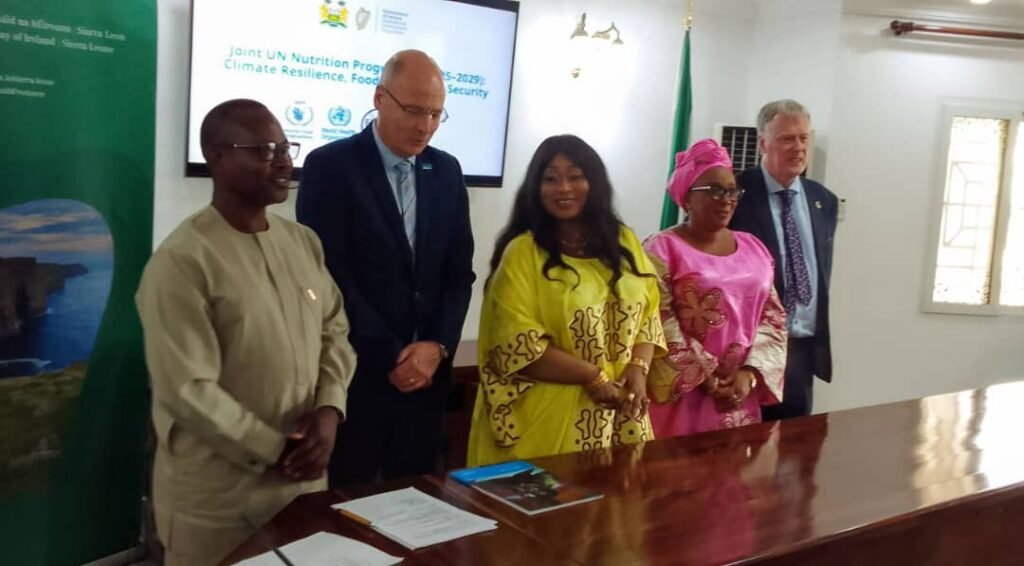
The Government of Sierra Leone, in collaboration with the United Nations and the Government of Ireland, has launched a Steering Committee to provide strategic leadership for the implementation of a Joint UN Climate and Nutrition Programme aimed at addressing climate vulnerability, food insecurity, and malnutrition in selected districts across the country.
The launch event took place at 11:00 a.m. at the United Nations Headquarters in Freetown and was attended by senior government officials, representatives of UN agencies, development partners, and members of Sierra Leone’s Fourth Estate, underscoring the national importance of the programme and its development impact.
The Joint UN Nutrition Programme is jointly implemented by the United Nations Children’s Fund (UNICEF), the Food and Agriculture Organization of the United Nations (FAO), the World Food Programme (WFP), and the World Health Organization (WHO). Programme implementation will focus on Bombali, Kailahun, Kenema, and Moyamba districts and will run through 2029. These districts have been identified as climate-vulnerable areas where food insecurity, malnutrition, and limited access to essential services continue to pose serious challenges.
The programme seeks to strengthen community resilience to climate shocks while improving access to nutritious food, quality health services, safe water, and sanitation. Through integrated interventions that link climate adaptation, food systems strengthening, and nutrition services, the initiative aims to address the root causes of hunger and malnutrition while promoting sustainable livelihoods at the community level.
The initiative aligns with the Government of Sierra Leone’s flagship Feed Salone priority under the Medium-Term National Development Plan (MTNDP) 2024–2030. It also contributes to the attainment of multiple Sustainable Development Goals (SDGs), including poverty reduction, zero hunger, good health and well-being, gender equality, clean water and sanitation, and climate action.
The Steering Committee serves as the highest decision-making and oversight body for the Joint Programme. Its mandate includes providing strategic guidance, ensuring effective coordination among all implementing partners, and overseeing the programme’s financial and operational performance. The committee will review and approve programme plans, monitoring and evaluation frameworks, and consolidated annual narrative and financial reports. It will also oversee independent evaluations and ensure follow-up on the implementation of recommendations.
The committee is chaired by the Government of Sierra Leone and co-chaired by the FAO Representative. Its membership includes representatives from Irish Aid, senior officials from the four participating UN agencies, the Office of the Vice President, the SUN National Coordinator, the Scaling Up Nutrition and Food Systems Coordination Unit, and key line ministries, including the Ministries of Agriculture, Health, Environment and Climate Change, and Water Resources and Sanitation.
At the initial stages of implementation, the Steering Committee will convene on a quarterly basis to provide close oversight and strategic direction. As the programme progresses, meetings will transition to a bi-annual schedule. Provision has also been made for ad hoc meetings to address urgent strategic or operational issues as they arise. In addition, an annual field visit to programme sites will be organized to enable members to directly assess progress, challenges, and results at the community level.
Decision-making within the committee will be guided primarily by consensus. Where consensus cannot be reached, decisions will be taken by a simple majority vote, with a quorum of five members required for official meetings. UNICEF, as the lead UN agency and designated administrative and convening agent, will serve as the Secretariat to the Steering Committee, providing coordination, documentation, and technical support.
The Joint UN Climate and Nutrition Programme is expected to play a critical role in advancing integrated, climate-resilient food and nutrition systems in Sierra Leone’s most vulnerable communities, reinforcing national development priorities while strengthening resilience against climate-related shocks.