By Hope Times News Desk
Engineering professionals in Sierra Leone have been urged to assume stronger leadership roles and actively contribute to policy formulation, infrastructure governance, and sustainable national development, as the Chief Executive Officer of the National Public Procurement Authority (NPPA), Chief Fodie J. Konneh, underscored the importance of professionalism, innovation, and strategic collaboration in shaping the country’s future.
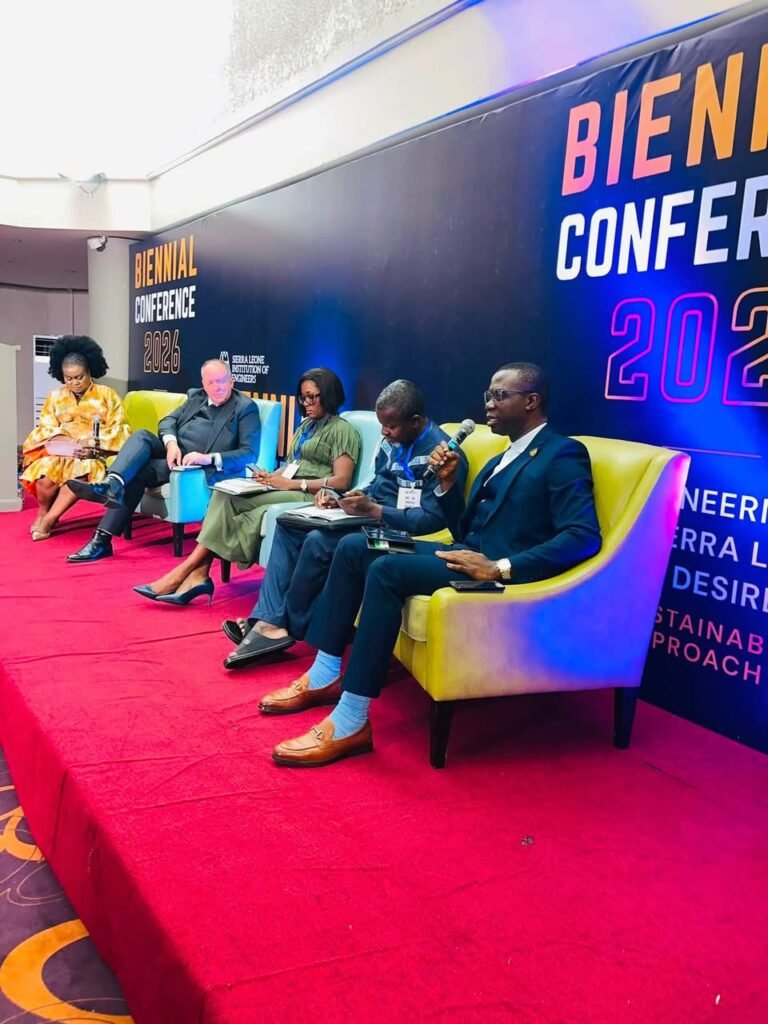
Speaking during a high-level panel discussion at the 2026 Biennial Conference of the Sierra Leone Institution of Engineers (SLIE), held at the Radisson Blu Mammy Yoko Hotel in Freetown, Chief Konneh stressed that engineering remains one of the most critical pillars for achieving sustainable economic growth and national transformation.
The conference, which was held under the theme “Engineering the Sierra Leone We Desire: A Sustainable Approach,” brought together engineering experts, policymakers, development partners, and private sector leaders from Sierra Leone and beyond to deliberate on issues relating to engineering leadership, policy, standards, and capacity development for nation-building.
The panel session, moderated by Ing. Trudy Morgan FSLIE, President of the Commonwealth Engineers’ Council, featured distinguished participants from Ghana, the African Development Bank, Sierra Leone, and representatives of the private sector. During his contribution, Chief Konneh emphasized that engineers should not merely be viewed as implementers of projects, but as strategic leaders whose expertise should influence planning, regulation, policy development, monitoring, and oversight.
According to him, engineering institutions must maintain their professional independence and avoid political interference, enabling them to provide objective, evidence-based advice on infrastructure projects and development policies. He urged the Sierra Leone Institution of Engineers to continue serving as an impartial professional body capable of guiding government and stakeholders on technical matters affecting national development.
Chief Konneh also reflected on Sierra Leone’s infrastructure legacy, noting that many roads, bridges, and public facilities built several decades ago remain functional today. He challenged engineers and policymakers to critically examine the differences between older and modern infrastructure and renew their commitment to quality, durability, and long-term sustainability.
He lamented the country’s poor maintenance culture, describing it as one of the major challenges undermining infrastructure investments. According to him, maintenance should be treated with the same seriousness as construction, adding that sustainable infrastructure requires structured maintenance systems, adequate funding mechanisms, and specialized technical expertise.
Highlighting the shortage of professionals in specialized engineering fields, Chief Konneh pointed to the recurring elevator breakdowns experienced in several facilities across the country as evidence of the need for more lift engineers and other niche specialists. He stressed that Sierra Leone must invest heavily in developing expertise in emerging areas of engineering to address modern challenges.
He further underscored the close relationship between engineering and urban planning, arguing that sustainable development can only be achieved through effective collaboration among engineers, architects, planners, environmental experts, policymakers, and other stakeholders. Such cooperation, he noted, is essential for creating resilient infrastructure capable of meeting the demands of a growing population.
Chief Konneh also drew attention to the Public Finance Management and Infrastructure Coordination Platform (PFMICP), an initiative he established to promote coordination among professionals involved in infrastructure development and public financial management. He encouraged engineers to take proactive measures in identifying challenges and proposing practical solutions capable of improving project delivery and infrastructure sustainability.
On the issue of human capital development, the NPPA Chief Executive called on universities, technical institutions, and professional bodies to broaden students’ understanding of engineering opportunities beyond the traditional disciplines of civil, mechanical, and electrical engineering. He explained that the country urgently requires experts in renewable energy, telecommunications, software engineering, biomedical engineering, environmental engineering, transportation engineering, and geotechnical engineering to support industrialization and technological advancement.
Linking engineering leadership to governance reforms, Chief Konneh highlighted several initiatives currently being implemented by the National Public Procurement Authority to improve public investment outcomes and enhance accountability. Among these, he referenced the recently completed Methodology for Assessing Procurement Systems (MAPS), which examined Sierra Leone’s procurement framework and identified key areas requiring reform.
He also described the introduction of the Electronic Government Procurement (e-GP) System as a major milestone in the modernization of public procurement. According to him, the digital platform minimizes human discretion, enhances transparency and accountability, and strengthens efficiency in the procurement process, thereby improving public confidence in government spending.
Furthermore, Chief Konneh disclosed that Sierra Leone is gradually shifting away from the traditional practice of awarding contracts solely based on the lowest bid. He explained that the adoption of Combined Weighted Evaluation methods allows contracts to be awarded to the Most Advantageous Bid, taking into consideration both technical quality and financial value in order to achieve better project outcomes and ensure value for money.
Concluding his remarks, Chief Fodie J. Konneh called on engineers to regard themselves as nation-builders and strategic partners in development. He maintained that stronger engineering governance, professional independence, specialized skills development, innovation, maintenance culture, and enhanced collaboration among engineers, procurement professionals, policymakers, and oversight institutions are indispensable for building resilient infrastructure and fostering sustainable national development.
He noted that the future of Sierra Leone’s development agenda depends largely on the ability of professionals to work collectively in creating durable infrastructure and effective systems that will benefit present and future generations.