By: Yusuf Ibrahim Kamara (The Wise Thinker)
The crucial role of the media in shaping national development, strengthening public trust, and supporting economic growth took center stage as the Managing Director and Chief Executive Officer of United Bank for Africa (UBA) Sierra Leone, Mohamed Alhajie Samoura, challenged journalists to embrace responsible journalism as a tool for nation-building and sustainable development.
Speaking as the keynote speaker at the 2026 Annual General Meeting (AGM) of the Sierra Leone Association of Journalists (SLAJ), held on 12th June 2026 at the University of Makeni (UNIMAK) Auditorium Hall in Makeni, Northern Sierra Leone, Samoura delivered an inspiring address on the theme, “Strengthening Sierra Leone’s Economy Through Responsible Journalism.” The event brought together journalists, editors, media owners, development partners, and communication professionals from across the country to discuss the future of journalism and its contribution to national progress.
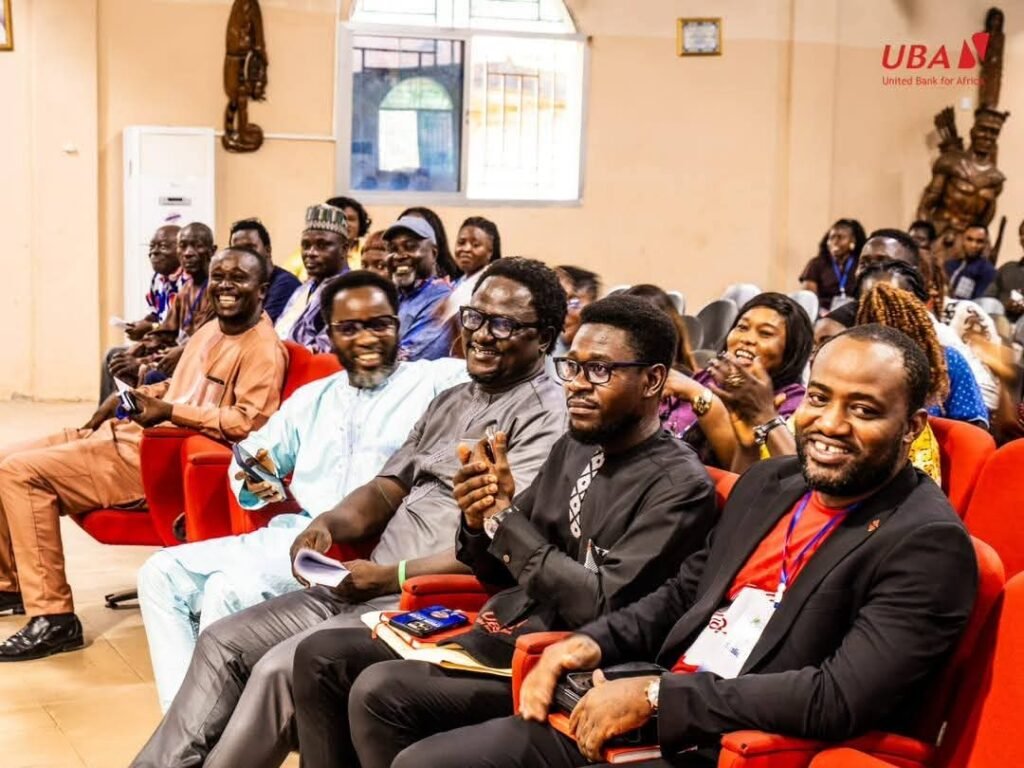
Throughout his keynote address, Samoura emphasized that journalism remains one of the most powerful institutions in society, capable of influencing public opinion, promoting transparency, strengthening democracy, and creating an environment that supports economic growth and investment.
His address, which combined personal reflections, practical insights, and a passionate call to action, quickly captured the attention of participants and set the tone for meaningful discussions throughout the conference.
One of the most memorable moments of the address came when Samoura openly declared, “I am a son of the media.”
The statement immediately resonated with the audience as he began sharing his personal connection to the journalism profession. He revealed that his father, Mohamed Samoura, was among the pioneering figures who helped establish the Sierra Leone News Agency (SLENA) and later served as a Commissioner of the Independent Media Commission (IMC).
According to him, growing up in a household where newspapers, radio broadcasts, and discussions on national issues were part of daily life instilled in him a deep appreciation for journalism and its importance in society.
He further surprised many participants when he disclosed that his own professional journey began in journalism. Before entering the banking sector, Samoura worked as a journalist at the Standard Times newspaper under the late veteran journalist Philip Neville.
The revelation strengthened his credibility among journalists attending the AGM, many of whom viewed his remarks as coming from someone who understood both the opportunities and challenges facing the profession.
Transitioning from his personal experiences, Samoura spoke extensively about the growing importance of responsible journalism in today’s rapidly evolving information environment.
He observed that technological advancements and the rise of social media have transformed the media landscape, making information more accessible than ever before. However, he warned that these developments have also contributed to the spread of misinformation, disinformation, and sensational reporting, all of which threaten public trust.
“Responsible journalism is no longer just a moral choice; it is the ultimate currency of trust,” he stated.
According to him, trust remains a critical ingredient for national development and economic progress. Investors, businesses, development partners, and citizens all rely on accurate and credible information to make informed decisions.
He argued that where trust is weak, economic opportunities become limited, and investor confidence declines.
“Capital is cowardly. It only goes where it feels safe,” he remarked.
The statement drew considerable attention from participants as he explained the direct relationship between credible journalism and a country’s economic attractiveness.
To support his argument, Samoura cited examples from across Africa, highlighting how responsible journalism and effective communication have contributed to national development in several countries.
He pointed to Ghana’s media environment as an example of how transparency and media freedom can help strengthen investor confidence, while Rwanda’s strategic communication efforts have significantly improved the country’s international image and attracted tourism and investment.
“The stories we tell about ourselves matter,” he noted. “A country’s image is one of its greatest economic assets.”
Turning his attention to Sierra Leone, Samoura stressed that responsible journalism should not be mistaken for avoiding criticism or concealing national challenges.
He encouraged journalists to continue exposing corruption, reporting on inflation, highlighting governance issues, and amplifying the concerns of ordinary citizens.
However, he challenged media practitioners to adopt a more balanced approach by giving greater attention to solutions-focused reporting.
“Report on the problems, but also report on the solutions,” he urged.
According to him, development journalism can play a transformative role by highlighting innovative ideas, showcasing successful initiatives, and encouraging public dialogue around practical solutions to national challenges.
He expressed concern that excessive focus on political disputes and controversy often overshadows important stories relating to agriculture, education, entrepreneurship, technology, infrastructure, healthcare, and financial inclusion.
One of the strongest moments of the keynote address came when he challenged journalists to familiarize themselves with Sierra Leone’s development agenda.
He questioned how many media practitioners had taken the time to thoroughly study the country’s Medium-Term National Development Plan and other strategic policy documents.
“We cannot build an informed society on a diet of political gossip while the plans for our country’s future gather dust on office shelves,” he stated.
Samoura encouraged journalists to deepen their understanding of national priorities such as the Feed Salone initiative, economic diversification programs, digital transformation strategies, and youth empowerment initiatives.
He argued that informed journalism is essential for effective public accountability and constructive national discourse.
By understanding development policies, journalists can ask more meaningful questions, monitor implementation more effectively, and provide citizens with the information they need to participate in governance processes.
Beyond discussing the broader role of journalism in development, Samoura also acknowledged the significant challenges confronting media institutions across Sierra Leone.
He recognized the financial difficulties experienced by many journalists and media organizations, including inadequate salaries, limited resources, rising operational costs, and declining revenues.
“We cannot talk about independent journalism if the journalist is hungry,” he observed.
His remarks drew attention to the difficult realities faced by media practitioners who often work under challenging conditions while striving to uphold professional standards.
Samoura warned that excessive dependence on political actors, individual sponsors, or occasional financial assistance could undermine media independence and compromise editorial integrity.
“If someone is the only reason your media house survives, it becomes difficult to hold that person accountable,” he cautioned.
To address these challenges, he called on media owners and the leadership of SLAJ to embrace innovation and entrepreneurship as pathways to sustainability.
He advocated for the adoption of digital business models, subscription services, specialized reporting, strategic partnerships, and institutional collaborations capable of generating sustainable revenue streams for media organizations.
He also encouraged greater cooperation within the media sector, including the possibility of strategic alliances and mergers that could strengthen media institutions and improve their competitiveness.
In reaffirming UBA Sierra Leone’s commitment to supporting the media sector, Samoura emphasized that investing in journalism should be viewed as an investment in national development rather than an act of charity.
“We do not see support for the media as charity. We see it as an investment in Sierra Leone’s development,” he affirmed.
As he concluded his address, Samoura reminded participants that the responsibility for building Sierra Leone rests with every sector of society.
He stressed that government alone cannot deliver national transformation, nor can the private sector achieve it independently. Instead, meaningful progress requires collaboration among institutions, citizens, businesses, civil society organizations, and the media.
“The future of Sierra Leone’s economy will not be written by government alone. It will not be written by the private sector alone. It will be written by all of us through the stories we tell, the truths we uncover, and the accountability we demand,” he declared.
His remarks received sustained applause from participants, many of whom described the keynote as one of the most insightful and impactful presentations delivered at a SLAJ AGM in recent years.
Several journalists praised the address for moving beyond ceremonial rhetoric and offering practical ideas that addressed both the challenges facing the media industry and the broader development aspirations of Sierra Leone.
Others commended Samoura for speaking from experience and demonstrating a genuine understanding of journalism’s role in society.
As delegates departed the UNIMAK Auditorium Hall, one message remained firmly etched in their minds: the future of Sierra Leone’s development is closely intertwined with the strength, credibility, and responsibility of its media.
In an era defined by information, public trust, and accountability, journalists have a unique responsibility not only to report events but also to contribute meaningfully to the nation’s progress.
For many who attended the AGM, Mohamed Alhajie Samoura’s keynote address served as a powerful reminder that responsible journalism remains one of the most important pillars upon which Sierra Leone’s future can be built.